
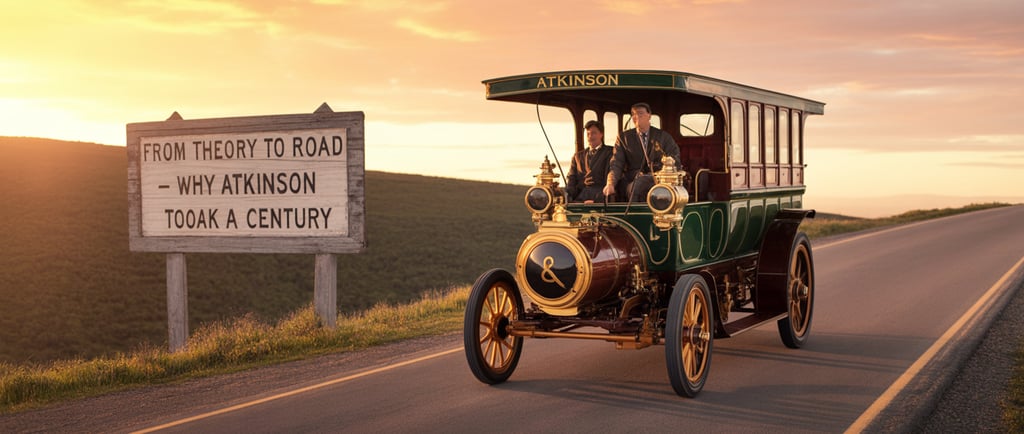
From Theory to Road — Why Atkinson Took a Century
From Otto to Atkinson, discover how engine innovation paved the way for Kaigia’s precise, efficient, and green Green Fuel Motor.
The Birth of the Four-Stroke Engine
In 1876, German engineer Nikolaus August Otto changed the world with his four-stroke engine, later called the Otto cycle. It followed the familiar sequence: intake, compression, combustion, and exhaust. For the time, it was revolutionary. But there was a catch: early engines converted only about 3% of fuel into usable energy.
A Rocky Road to Success
Otto’s journey was far from smooth. In 1861, he and his brother tried replicating Lenoir’s gas engine, but their first patent attempt failed. Undeterred, Otto teamed up with mechanic Michael Zons in 1862, refining the design piece by piece. Money was tight — at times he almost went broke — and he even worked for Carl Mertens just to fund his research.
By 1872, things started looking up. Otto partnered with Eugen Langen to form Gasmotoren-Fabrik Deutz, where Gottlieb Daimler and Wilhelm Maybach joined as technical directors. Otto focused on business, while Daimler and Maybach pushed the technical limits of the engine. Together, they were shaping what would become the modern internal combustion engine.
The Patent Twist
In 1877, Otto secured a U.S. patent for his four-stroke engine. But history had a twist: French engineer Alphonse Beau de Rochas had already patented the theoretical four-stroke cycle back in 1862 — though he never built a working engine. Legal challenges followed, and by 1886, Otto’s patent was revoked. Even the most brilliant inventions aren’t immune to history’s quirks.
Atkinson and the Pursuit of Efficiency
Early Otto engines were powerful, but inefficient. Enter James Atkinson in 1887, who designed an engine that extended the expansion stroke relative to the compression stroke. This meant more energy was used for work rather than lost, boosting efficiency — though at the cost of peak power.
Decades later, Ralph Miller (1957) simplified this idea. Instead of complex mechanisms, he simply kept the intake valve open longer, achieving Atkinson-like efficiency while keeping power output practical.
Modern Applications
By the late 1990s, Toyota revived the Atkinson cycle in the first-generation Prius, pairing it with an electric motor to compensate for lower torque. Variable Valve Timing (VVT) allowed engines to switch back to the Otto cycle when more power was needed.
Meanwhile, Mazda experimented with the Miller cycle in the KJ-ZEM and later in Skyactiv-X, combining a supercharger, Miller cycle, and Spark Controlled Compression Ignition (SCCI) to push efficiency and performance even further.
Engineering Ingenuity Across the Ages
Engineers have consistently found clever ways to overcome the challenges of efficiency and performance, from turbocharging and direct injection to boost power and fuel economy, to variable valve timing that adapts the engine across different speeds and loads. Techniques like water injection and ceramic coatings help reduce heat losses, while the use of lightweight alloys and advanced composites improves both durability and overall performance.
Today: Precision, Efficiency, and Kaigia
The evolution from Otto’s first four-stroke to modern hybrid engines shows one thing clearly: precision matters. Early engines approximated ideal cycles, but timing, geometry, and material limits always left room for inefficiency.
This is exactly the problem Kaigia solves with its Green Fuel Motor (GFM). Whereas conventional crankshaft engines only approximate Otto or Atkinson cycles — with pistons moving near a “constant volume” point but deviating from the ideal thermodynamic path — Kaigia controls piston trajectories with surgical precision. Every phase — compression, combustion, expansion, scavenging — aligns perfectly with its theoretical state.
The benefits are immediate: higher efficiency, better performance, and the ability to run fuels previously impractical for mobility, including hydrogen, ammonia, and advanced biofuels. And thanks to its modular architecture, Kaigia’s system can scale from light drones to heavy freight vehicles, achieving zero-pollution deployment across all platforms.
In other words, the spirit of innovation that drove Otto, Atkinson, and Miller forward is alive today in Kaigia: solving longstanding engineering challenges with clever, precise, and adaptable solutions.
Note: This article was crafted with the assistance of AI to ensure clarity and coherence.