
Cold Roads, Warm Hearts: A Ski Trip That Hints at Mobility’s Future.
A winter journey with two families shows how different vehicles handle long trips in cold weather, highlighting the opportunities and innovations shaping the future of clean, efficient, and flexible mobility.
The Journey Begins
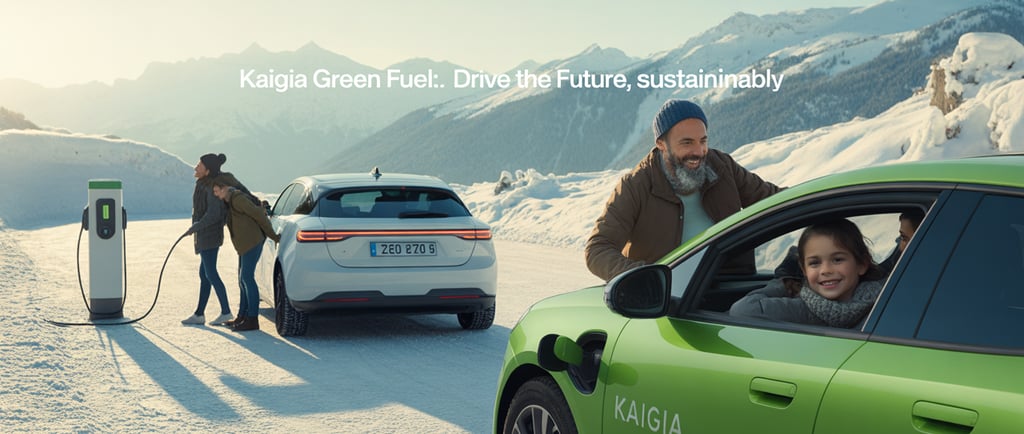
In the heart of winter, two families embarked on a ski trip to Les Arcs. The Martins set out from Amiens, while the Duponts began their journey from Frankfurt. Each family faced roughly 800 km of travel through snow-dusted roads and freezing temperatures. Between them they had four children—Lina, Max, Zoé, and Hugo—all buzzing with excitement. Both vehicles would face challenges in cold weather, offering insights into the evolving landscape of mobility.
Winter Realities on the Road
The Martins, in their electric vehicle, planned a couple of charging stops. Winter conditions slowed charging slightly, and at one station a queue added unexpected delay, prompting them to adjust plans. Despite these challenges, they arrived later in the evening, tired but relieved. The Duponts, traveling in a gasoline car, experienced a more straightforward journey, arriving mid-afternoon and settling in comfortably.
A Conversation Over Beers
The next day, while the kids skied, the two fathers compared experiences. The Martin father noted that while the EV handled the journey capably, a small onboard range extender could have added flexibility. They also reflected on the electricity powering the EV, recognizing that the overall efficiency and environmental impact depend on the grid mix and the full chain from generation to wheels. Meanwhile, the Dupont father described how their conventional car handled the trip. Both looked out over the darkened, slightly blackened snow, a quiet reminder of the traces of pollution that even winter landscapes carry. They agreed that achieving true net-zero mobility requires a combination of clean power sources, smart engineering, and advanced fuels.
Enter Kaigia
That’s where Kaigia comes into view. Traditional engines approximate ideal combustion cycles, but Kaigia’s Green Fuel Motor (GFM) precisely controls piston trajectories, aligning each phase—compression, combustion, expansion, and scavenging—with its theoretical optimum. This innovation enhances efficiency and makes it possible to use advanced clean fuels like hydrogen, ammonia, or biofuels, all within a modular design capable of powering anything from light drones to heavy freight. The same system can serve as a compact range extender, letting EV drivers confidently minimize battery size, while vehicles powered by green fuels enjoy rapid refueling with zero exhaust emissions. The story is a reminder that with smart engineering, mobility can be seamless, efficient, and sustainable.
AI-assisted content. For general understanding only; energy systems evolve rapidly—verify current information before acting.